
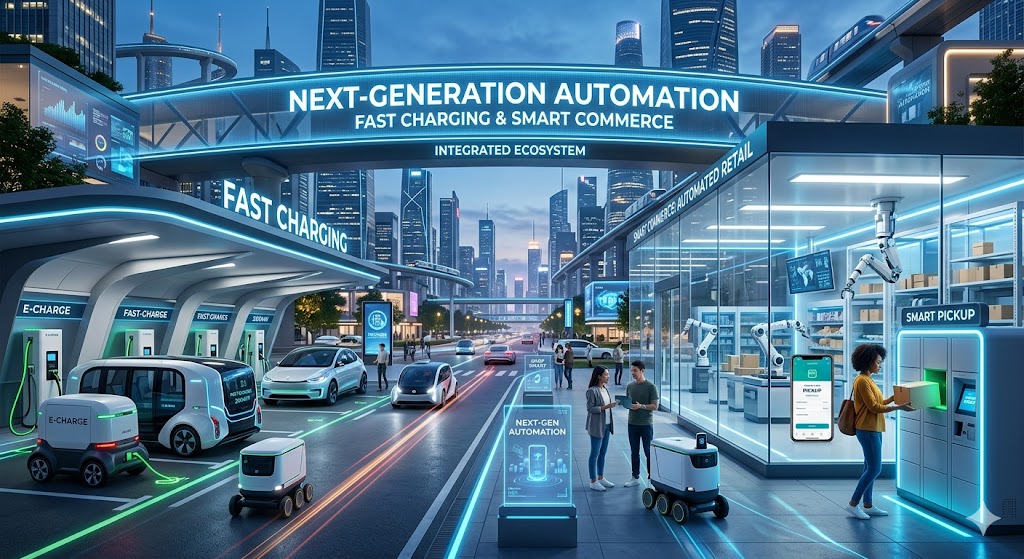

Despite infrastructure hurdles, practical innovations in automation and hardware continue to reshape daily commerce and transport. Chinese electric vehicle powerhouse BYD has disrupted the automotive market by demonstrating a revolutionary “Flash Charging” system. Utilizing advanced thermal management and chemistry, the system can completely top off an EV battery in under ten minutes, threatening to eliminate range anxiety entirely. The concept of speed is also transferring to the retail sector through a major partnership between Visa and OpenAI. By integrating Visa’s massive payment network directly into ChatGPT, the companies are paving the way for autonomous AI agents capable of securely browsing, selecting, and purchasing physical goods on behalf of human users, fundamentally altering the e-commerce pipeline.
BYD’s “Flash Charging” breakthrough addresses the single greatest obstacle to widespread electric vehicle adoption: refueling downtime. Traditional fast-charging systems often require anywhere from thirty to forty-five minutes to achieve an 80% charge, a duration that many traditional combustion-engine drivers find unacceptable for long-distance travel. BYD’s new technology achieves a full 100% charge in less than ten minutes by utilizing a proprietary liquid-cooling architecture built directly into the battery chassis, preventing the catastrophic overheating that typically degrades battery health during high-voltage transfers. If successfully deployed across global charging networks, this technology could permanently shift consumer sentiment and accelerate the decline of fossil-fuel dependency.
While BYD automates physical transit, the partnership between Visa and OpenAI aims to automate the financial transactions that define daily life. The integration of a global payment network into an advanced AI model allows ChatGPT to evolve from a passive informational tool into an active economic actor. Under this new framework, a user can grant the AI a specific budget and a objective—such as “buy me a durable winter coat under two hundred dollars with good reviews”—and the agent will navigate the web, evaluate products, securely authenticate the payment via Visa’s tokenized security layer, and arrange shipping without requiring the user to ever open a browser tab or enter a credit card number.
This concept of autonomous commerce raises profound questions about consumer psychology and market competition. Traditional retail relies heavily on impulse buys, visual branding, and search engine optimization to attract human eyeballs. In a world where an AI agent acts as an intermediary shopper, those traditional marketing levers become completely obsolete. Brands will no longer compete for human attention; instead, they will have to optimize their product data feeds for machine algorithms, proving their value through objective specifications, verified reviews, and price efficiency. This could lead to a hyper-rationalized marketplace where lesser-known brands can easily unseat industry giants purely on merit and value.
However, the thought of turning financial agency over to software algorithms introduces significant security and ethical challenges. Visa and OpenAI have emphasized that the system utilizes multi-layered biometric approval prompts, localized spending caps, and strict cryptographic sandboxing to ensure that an AI cannot go rogue or fall victim to digital pickpocketing. Despite these assurances, cybersecurity experts warn that malicious actors will inevitably attempt to exploit these autonomous agents through prompt-injection attacks, tricking the AI into purchasing fraudulent goods or transferring funds to unauthorized accounts. As this technology moves into public beta, the balance between convenience and financial security will be tested on a global scale.


 English