
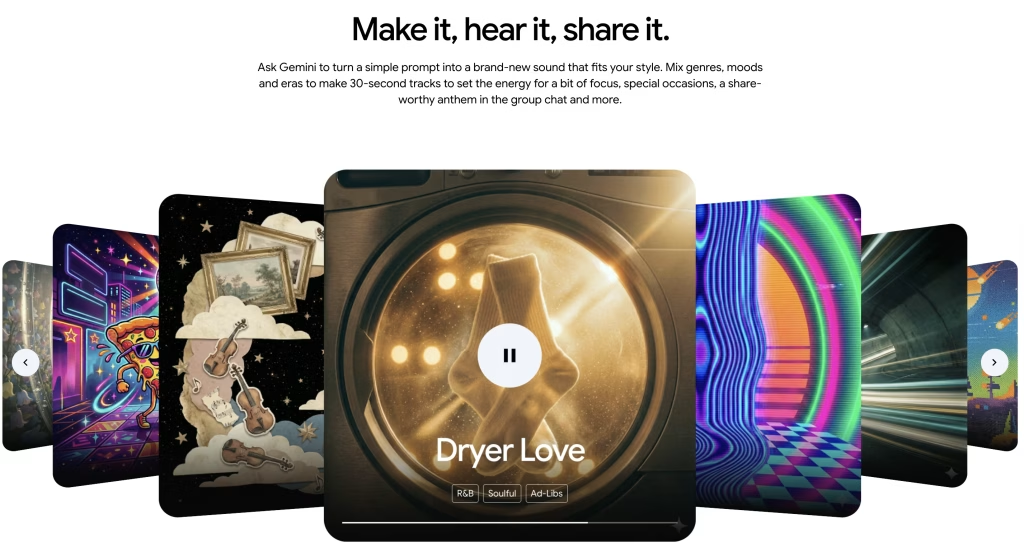

Google DeepMind has unveiled Lyria 3, its latest artificial intelligence music generation model, bringing real-time, professional-quality music creation directly to users of the Gemini app. The rollout, which began in early 2026, represents a significant evolution in AI-assisted creativity, combining DeepMind’s expertise in generative AI with Google’s ecosystem of tools and apps to make music generation accessible, fast, and highly customizable.
Unlike earlier AI music tools, which often required manual sequencing, lengthy prompts, or specialized software, Lyria 3 offers an intuitive interface within Gemini. Users can simply describe the type of music they want — from genre and mood to tempo and instrumentation — or upload images or videos to inspire musical interpretation. In seconds, the model produces a fully formed 30-second track complete with instruments, vocals, and lyrics when requested.
One of Lyria 3’s most notable features is its visual-to-audio capability. By analyzing uploaded photos or video clips, the model interprets visual cues such as colors, movement, and context to generate music that reflects the mood or narrative of the imagery. For instance, a bustling cityscape can produce upbeat electronic rhythms, while a quiet forest scene might yield ambient acoustic melodies. This creates a seamless fusion of sight and sound that opens new avenues for creative expression.
Lyria 3’s vocal capabilities are equally impressive. Users can select the style, language, and tone of vocals for their tracks, and the AI will generate accompanying lyrics or sing prewritten lines in multiple languages including English, Spanish, French, Hindi, Japanese, and Korean. Google emphasizes that the model avoids replicating specific artists’ voices or copyrighted material, instead producing original content inspired by genre and stylistic cues.
To ensure transparency and ethical usage, every Lyria 3 track is embedded with SynthID, an imperceptible audio watermark that signals the AI origin of the content. This feature enables users and platforms to distinguish AI-generated music from human-composed tracks, addressing concerns about originality and potential misuse. Google has positioned this as a key part of its responsible AI strategy, along with copyright-conscious training practices and user guidelines.
Integration within Gemini allows Lyria 3 tracks to be exported with custom cover art, also AI-generated, making them ready for social sharing, streaming platforms, or personal libraries. Users can adjust parameters such as instrumentation, tempo, harmony, and vocal style, giving creators control over the final output while retaining the convenience of instant generation.
Google has also leveraged Lyria 3 for special themed experiences. For example, users could generate Lunar New Year music using their own names, hobbies, and preferred musical styles, resulting in festive, personalized tracks with accompanying lyrics and artwork. These features demonstrate how the model is designed not only for general creative tasks but also for seasonal or event-driven applications.
Despite its strengths, early feedback highlights some limitations. The 30-second track length may feel restrictive for certain projects, and the quality of output can depend heavily on prompt specificity and clarity. Some users note that longer or more complex compositions may require multiple iterations or manual assembly in other software. Nonetheless, for quick, expressive music generation, Lyria 3 is a powerful tool for creators of all skill levels.
The potential impact of Lyria 3 extends beyond casual creation. Independent musicians, content creators, and educators can leverage the model to experiment with new sounds, generate backing tracks, or enhance multimedia projects without the need for expensive hardware or deep production expertise. It is particularly compelling for social media users seeking unique audio for short-form videos, reels, or podcasts.
By bringing Lyria 3 into the Gemini ecosystem, Google DeepMind has effectively merged state-of-the-art AI research with user-friendly accessibility. The model demonstrates that AI-generated music can be intuitive, high-quality, and immediately useful — transforming how people think about composition and creativity in the digital age. As Lyria 3 continues to evolve, it is poised to redefine the boundaries of music production, democratizing creative tools and empowering millions of users to compose music in ways that were previously unimaginable.


 English